Sunday, July 13, 2014

From Lisbon with love


The first thing we saw driving into Lisbon from the south is a large concrete statue of Jesus inspired by the one in Rio de Janerio. Then you cross a bridge that looks like a smaller version of the Golden Gate. From the highway, we can see how hilly the city is and how much water surrounds it. Lisbon topples down the hill to the bay, jam packed with building, narrow streets, alleys and staircases. Trolleys ply the tracks taking mostly tourists up and around the town. From the vantage point near our apartment, the port looked like Seattle’s with container ships, tour boats and recreational vessels tightly vying for space. We climbed to the top of Castel San Jorge to see all around the city, from what looked like the financial business district of metal and steel to the historical area we had just a walked through and all around the bayfront. Ferries cross the bay to outlying suburbs. This could almost be the Bay Area or Seattle except that this has been going on here for a thousand years longer. There is something rather haunting about Lisbon, it lacks the shiny veneer of the other cities that we’ve seen and perhaps it’s the Fado music. But it would take much more time than we have here to uncover what that is. Onward: Galicia beckons.

A meager attempt to capture a sense of Lisbon


Friday, July 11, 2014

From Paris to Atlanta

In the immortal words of my dear friend Linda Hunt “Life is what happens when you are making plans”. Sure enough, while in Barcelona (6/10) my brother Bill in Atlanta rang me on Skype to say that he was in the hospital. He’d been sick when we were all together in Tahoe and it was distressing to hear that he hadn’t improved and had in fact gotten much worse. Three days later we find out that it’s leukemia. He’s being transferred from the hospital to the Emory University Winship Cancer Center to begin treatment ASAP. A week of 24 hour chemo to start and then determine next steps. There’s been a lot to process, so grateful for Skype, Imessaging and Facetime to be able to keep in touch. Just a few days ago we learned that initial treatment revealed some facts that make this a longer-term treatment. The prognosis is good and we believe Bill will get through this and into full remission with the grace of God.


For Jeff and I, it’s been cause for lots of reflection. When someone you love, who shares your DNA, who’s always been there gets so sick like this, it really causes you to think about what’s most important. Luckily, it’s not a crisis situation, Bill’s in good hands, his wife Lu Anne is incredible, and they have amazing support from their community. They don’t need us. But we need to be with them, spending time, helping out if we can but also just being a part of the healing process. Be a part of Team Rowlett. So we booked our tickets from Paris to Atlanta on 8/25 and will take a break from our trip. We planned this trip loosely so allow for flexibility and are so glad we have it. In the meantime, we will continue through Spain and into France per our initial plans, toasting Bill’s short recovery and long life all along the way.
Team Rowlett in Tahoe May 2014

Tuesday, July 8, 2014

Alvor, Portugal: A vacation from traveling

Today marks six weeks in Europe. We have six weeks to go before we use up our allowed ninety days and have to retreat to the UK and Ireland. We’ve seen a lot, missed a lot, and put some miles on old Bridget. Indeed, it is such a privilege to have this time to explore and see at our own pace.

When we started looking for a place to explore southern Portugal (the Algarve), the first thing we read about was how over-developed it is. They started building resort condos in the 60’s along this coast and it felt daunting to find the right place. We settled for Alvor, just west of the city of Lagos. From what we could see, it was a small fishing village that still retained some traditional charms. So we pulled out of Seville with the GPS set to our Alvor apartment’s address and took off for Portugal.

Small traditional fishing villages that are surrounded by tourist areas don’t exactly lend themselves to good GPS directions. We pulled into town and got led in circles along the very narrow streets as the GPS kept refiguring to find our street. Finally after getting blocked by a delivery truck, I got out and walked a few yards and there it was! We met our hosts Dulce and her daughter Ines who introduced us to our apartment.

One reason we have loved our stay here so much is because of this apartment. Ines is an architect in Stockholm and they lovingly refurbished an old fisherman’s apartment with local materials and a clean functional aesthetic. “We wanted visitors to be able to look at the sea from all rooms” Ines told me. Mission accomplished. Our windows look over an ever changing view of the harbor, fishing huts, a small childrens park and a beautiful large dune system, interlaced with boardwalks out to the Atlantic Ocean. The city of Lagos is visible in the distance along with rocky bluffs that jut out into the sea. It’s better than TV.

We didn’t realize how much we needed a rest from all that history, beauty, art, architecture, jamon, and just being a tourist. This has been the perfect place to read, relax, draw and bird watch. Alvor is located on Alvor bay, fed by the Alvor river, historically diked for agriculture at one time (WAFO folks: it’s the Port Susan Bay of Portugal). The whole area is now part of the EU’s Nature 2000 program. We’ve seen stilts, cranes and a pair of flamingos. Just quiet, peaceful and beautiful.

Buying fresh fish, a farmers market loaded with fruit and vegetables, a nice kitchen with a view to cook in. Walking in the dunes and estuary, those will be our memories of Alvor. Hope to come back someday and actually see the array of historical sites in this area. Next stop Lisbon for a few days before we re-enter Spain in Galacia, an area touted to resemble home (Pacific Northwest).  


Saturday, July 5, 2014

Time traveling in Seville

Time flows so differently on the road. So much is seen and even more is left unseen when you move through three cities too fast. The last city in this tour was Seville. It went by in an instant. Poor travel planning on our part not to give more time to that remarkable city. Seville has too many alleys, plazas and roads to explore and centuries of history for a mere two and a half days.

Historical time travel in Seville is impossible to miss given its role in Spain’s empire from the late 1400’s until sometime in the 1900’s. This is where the plans were made to explore “the new world”. The Seville Cathedral was built to demonstrate Seville’s wealth. As the third largest in the world, it holds priceless treasures such as a 20-foot high silver alter (some of it melted down by Napoleon to pay for that war). Paintings, gold and silver relics. Even some remnants of Christopher Columbus in an elaborate crypt are interred here. The story goes that his remains traveled from Hispanola to Cuba and finally to this cathedral around 1900. A vast, mind-boggling space inside with too many facts and statistics attributed to it for me to bore you with here. That’s what Wikipedia is for.

On day two we explored the Real Alcázar, a palace that is still used today by the king of Spain when visiting Seville. Built on a Moorish palace and revised/added onto by succeeding kings from the early 1400’s is another Moorish/gothic culture clash.  Time got away from us there and we spent the day exploring the gardens and never got around to that bike ride we going to take to see a few more sites. And that was a shame because Seville has an amazing bike trail system.

Then it was time to go, our next stop southern Portugal. So long Seville, we’ll plan much more time for the next visit.


Wednesday, July 2, 2014

Down by the River... in Cordoba

The second city of this well-traveled arch we are on was Cordoba. We didn’t really know what to expect and had heard from David and Simone how much it surprised them. Looking for surprises is always a good mindset for entering a new place and it served us well in Cordoba. The first, as always, was our apartment. We met yet another wonderful AirBnB host, Juan Carlos (also the name of the former King of Spain) who insisted on practicing his English with us. It was much better than our Spanish. His apartment was on the edge of the old city allowing us to feel like we were in a real neighborhood and be able to get into the old part of the city without much problem.

We’ve gotten in the practice of doing an orientation walk the first night we land in a new place. It was so hot this first day that we waited until 9 pm to get out and we wound our way through the narrow streets and allies. A surprise around every corner: a funeral procession; masses that were just finishing up; small plazas with the ubiquitous cerviceria/bar/café tables filled with people. Our destination was the river. The mighty Guadalquivir flows through here, we’d crossed it twice before in the Alpujarra and along the coast by Nerja.  There is an old roman bridge we wanted to walk across and see the Mezquita from the outside.

The river did not disappoint and the other side of the river was a real surprise. We stumbled up on a street fair with booths of food, families, kids taking rides on donkey’s and a stage with what we think was traditional dance and music from Galacia. The view across the river towards Cordoba was beautiful and the energy of the families and everyone out enjoying the evening was magnificent.

We toured the Mezquita the next day, an amazing Mosque-Cathedral with an complicated history that I can’t begin to write about. The juxtaposing of Islam and Catholicism was simply captivating. And it’s Ramadan now. No Muslims practicing here: banned by the Vatican. Seems unfair given that this was once a rival to Mecca when the Moors owned this part of Spain. Outside this complex a Jewish neighborhood: the religious trifecta is a common history here in Spain.

We visited the river again on our second evening and the street fair was gone but the view was still there. This time there was a Flamenco show on the stage by the bridge, a man with two guitars and three vocalists behind him. Mesmerizing. Another great surprise by the river. 

Cordoba had such a friendly, laid back feel, of a city that’s proud of it’s heritage and comfortable with being the “lesser known” city to Granada and Seville. Once again, not enough time. We are beginning to feel like this is the “taste of Spain”, finding places to return to on our next trip.

(And happy birthday Elizabeth, we are sending you love and feliz cumpleanos from Spain!)


Monday, June 30, 2014

Gracias Granada


We pulled into Granada off the autopista and found ourselves in a block of soviet style apartments that housed our recent booking on AirBnB. The neighborhood was unattractive, had no parking and we became a bit discouraged by where we had landed. Doubt disappeared when we met our delightful host, Paola. She helped us get our car into her rabbit warren of a garage, showed us the apartment and gave us a map. From there, we just started walking. Right outside our building was a small river that provided a gentler introduction to the city. On our evening paseo, Jeff had found a nice walk along the River Darra below the Alhambra. At trails end we noticed a road that seemed to go up so we followed it. It wound up to the top of the Alhambre and we were rewarded with a stunning view of the city from the olive orchard. We could see the Sierra Nevada to the east and the plains to the west. Great perspective. (Thanks for this suggestion Denise!) We bushwacked down from the orchard, picked a road that wove down through more neighborhoods. It was fascinating: We were enchanted. We celebrated by finding the best rooftop bar in the city. And the next day was similar, again, Jeff found a neighborhood that afforded more views of the Alhambre and provided endless alleys, stairs, and cobbled streets to explore. We finally got into the Alhambre that night, it was amazing as you know if you have been there, and pictures do not do it justice. You’ll just have to go and see it yourself. And do take time to walk around town, it’s a treasure. Gracias Granada. 

Granada: It's all about the Alhamra. And wandering.

Sunday, June 29, 2014

Alpujarras: Driving over lemons

Las Alpujarras are part of Spain's Sierra Nevada. Beautiful mountains, old traditions, great hiking and not enough time to explore. Have been reading a lovely book by retired Genesis drummer, Chris Stewart called Driving Over Lemons about his adventures buying an Alpujarran cortijo with no water, electricity or road and moving there to raise a family and a large herd of sheep. On the list for the next visit to Spain: walking tour of the Alpujarras.

Driving into the mountains with the hill of Pampaneira in the distance.

Saturday, June 28, 2014

The white village of Frigiliana

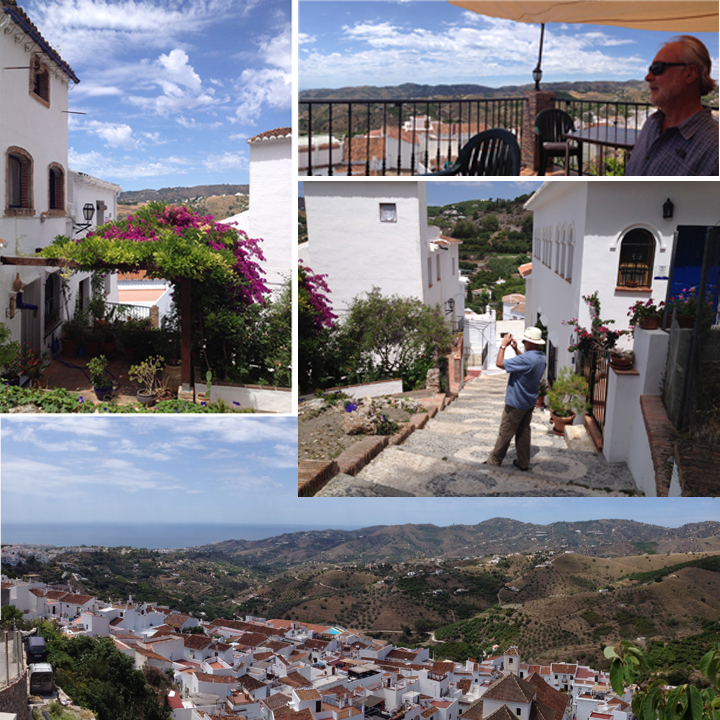
Frigiliana: While we were in Motril, we spent the day walking through the "white village" of Frigiliana. About 6 KM up from the Mediterranean, it clambers up the hill along the top of a valley. Entering at the bottom, which was already starting to show the promise of some amazing views, we wound our way up through beautiful, narrow alleys punctuated with geraniums, bouganvilla and other semi-tropical flowers. This place was just crazy scenic. Everywhere was a picture. At the top the view went over the village to the sea. We enjoyed a fabulous lunch spot, toasted our very great, good fortune and left with lots of bad photos but great memories.

Friday, June 27, 2014

Costa Tropical


We spent a relaxing week in Motril, on what’s called the Costa Tropical. Motril has a relaxed, beach town vibe, with a city center about a mile from a stretch of beach that features a vibrant port that houses cruise ships (they bus passengers up to Granada from there) and a ferry to Morocco. It’s a fairly new town of about 61K people, felt like my hometown of Bradenton a wee bit. We were there during the Noche de San Juan where people enjoy a night between fire and water. A bonfire burns all night and there is lots of food and music. The fire symbolizes the burning of the past and the water purifies for future wishes. It’s the first party of many that mark the summer in this part of Spain. Now onto Granada, Cordoba & Sevilla before ducking out of Spain into Portugal...


Thursday, June 26, 2014

the polythene coast

Spain names each of it's coastal areas to reflect something unique. We were on the Costa Brava north of Barcelona and the Costa Dorada in Delta l'Ebre. It was a great shock to come over the arid Nevada-like hills of Murcia and see the Polythene Coast. The coastal plain of Almeria has the largest concentration of greenhouses on the planet. Towns have been swallowed up. They are vast. We went to one beach where you drove through a greenhouse canyon to reach the beach with greenhouses all the way to the water. Somehow people ignored this odd backdrop and enjoyed the beach. This is the cost of having vegetables and fruit year round. This website has more photos and a short article.